
Generative Engine Optimization: get your brand into AI answers
Generative Engine Optimization (GEO) is the work on your website and brand reputation that makes ChatGPT, Gemini, Perplexity and Google AI Overviews find, mention and cite your company in their answers. We work in three areas: technical access for AI crawlers, content that is easy to cite and brand mentions on authoritative sites.

What are GEO services and how does AI choose its sources?
Generative systems build an answer from two sources: knowledge the model absorbed during training, and pages they find in a search index at the moment of the query. GEO works with both: it makes your site accessible and understandable to AI search bots and increases the number of brand mentions in the sources models trust.
Every system searches differently. Google AI Overviews and Gemini rely on the Google index, ChatGPT uses its own OAI-SearchBot crawler when it searches, and Perplexity has its own search bot and web index. Technical requirements therefore differ, and we run a separate track for each system: ChatGPT & Copilot, Google AI Overviews & Gemini, Perplexity.
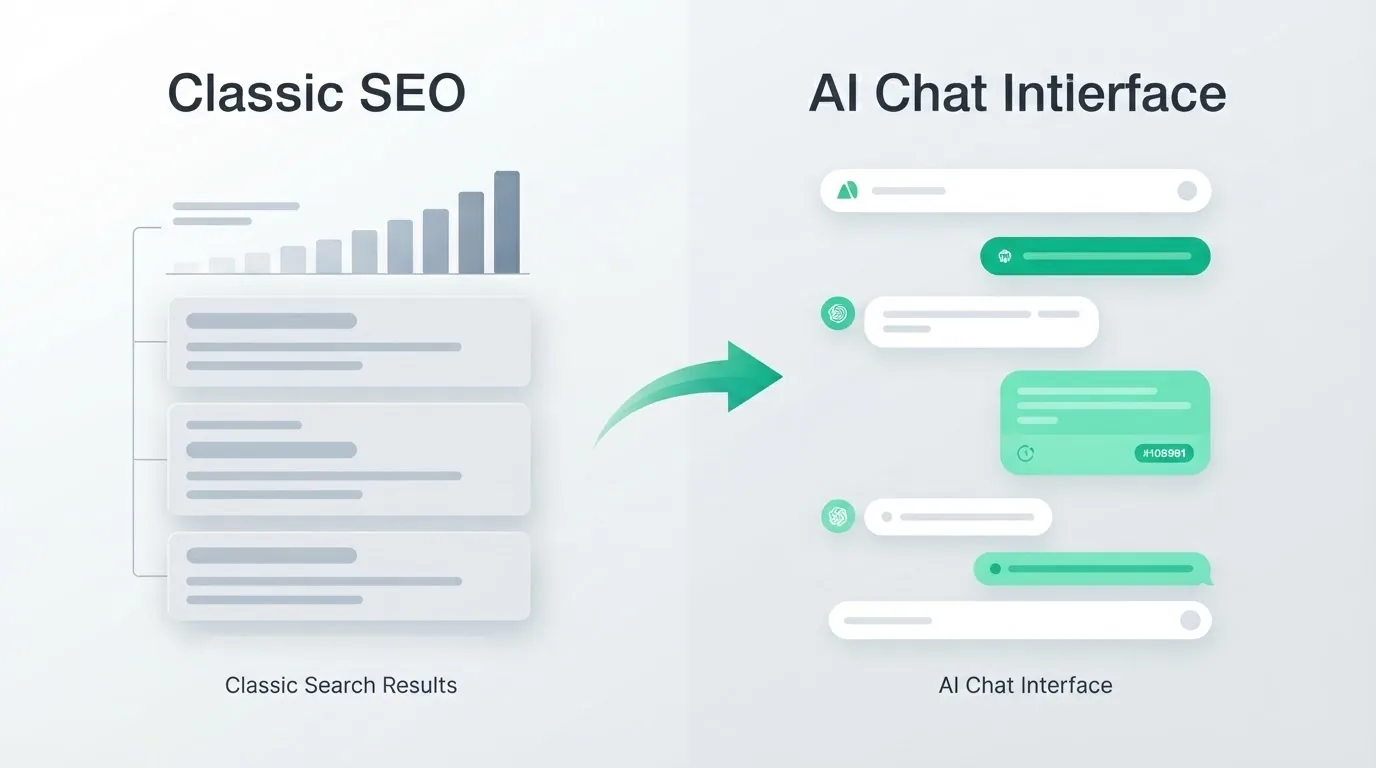
How is generative engine optimization different from classic SEO?
| Parameter | Classic SEO | GEO services |
|---|---|---|
| Goal | Page positions in search results | Brand mention and citation inside an AI answer |
| What the user sees | A link in a list of results | A recommendation or a source inside the answer |
| Key signals | Relevance, technical quality, links | The same, plus brand mentions on third-party sites, clear factual answers and consistent company data |
| How we measure | Positions, traffic, conversions | Share of mentions across a query set, site citations, visits from AI services |
GEO does not replace SEO, it builds on top of it: a page that search engines find poorly rarely makes it into an AI answer either.
Who needs AI search optimization?
- 01
Customers ask AI whom to choose
Queries like "recommend an agency", "which clinic to choose" or "compare these services" are increasingly typed into a chat. If your brand is missing from the answer, AI names your competitors.
- 02
AI already says something about your brand
And not always the truth: outdated prices, services you do not offer, someone else's reviews. These errors are fixed through the sources the model relies on.
- 03
A top Google ranking does not guarantee a mention
Only a few sources make it into an AI answer. A page can rank in the top ten, yet the model will cite another one where the answer is worded more clearly or the brand is mentioned more often.
Getting cited by AI pays off most in niches where customers pick a provider on recommendation: dentistry, law firms, online stores, B2B services and SaaS.
How we run GEO services: 5 stages
Every stage has a concrete deliverable that you see in the report.
AI visibility audit
We check what ChatGPT, Gemini, Perplexity and AI Overviews answer to queries in your niche and whether they mention your brand.
- A set of 30–100 queries your customers ask: commercial, comparison and informational.
- Recording which competitors are mentioned and which sources AI links to.
- Finding errors and outdated data about your brand in the answers.
Technical access for AI crawlers
AI will not cite a page that its bot cannot open or read.
robots.txt for AI bots
We configure access for search bots (OAI-SearchBot, ChatGPT-User, PerplexityBot) separately from model-training bots (GPTBot, ClaudeBot, Google-Extended), so you decide what to allow. More about the file in the robots.txt glossary entry.
Server-side rendering and structured data
Content is available without JavaScript, and Schema.org markup (Organization, Service, Article, FAQPage) describes the company and services as entities.
llms.txt as an extra signal
We create the file for AI agents but do not build the strategy on it: studies do not yet show an effect on citations. Details in our article on llms.txt.
Content that AI can cite
Models cite pages with a clear answer and verifiable facts more willingly.
- A direct answer right under the heading, then details and examples.
- Facts, figures and data with a link to the source.
- Comparison pages and FAQs built on real customer queries.
- Authors with proven expertise and profile pages.
Brand mentions and external authority
For AI recommendations, what others write about you matters, not only your own site.
- Mentions in industry media, directories and review platforms that AI cites in your niche.
- Consistent company data everywhere: name, services, contacts, profiles (
sameAs). - Fixing inaccuracies in the sources from which AI takes wrong data.

Monitoring and reports
AI answers change, so we measure visibility regularly, not once.
- Repeated measurements on the same query set.
- Dynamics of your brand's share of mentions compared with competitors.
- A report: what changed, which sources are cited, what we do next.
How we measure results
We measure results on a fixed set of queries from your niche: how often AI mentions the brand, whether it links to your site and how many visits come from AI services. We check each query several times, because AI answers differ even for the same question.
Share of mentions
In how many answers across the query set your brand appears.
Site citations
How often AI links to your pages specifically.
Position in the answer
Whether the brand is named first or at the end of a list.
Traffic from AI services
Visits from chatgpt.com, perplexity.ai, copilot.microsoft.com and others in your analytics.
What do you get as a result?
Visibility in AI answers
Your brand appears more often in answers to niche queries, which you can see in regular measurements.
Traffic from AI services
Visits from ChatGPT, Perplexity, Copilot and AI Overviews are tracked separately in analytics.
Stronger SEO
Technical quality, structured content and brand mentions also support your Google rankings.
Where to start
Everything starts with a free analysis: we check what AI currently answers about your niche and brand, and prepare a strategy with priorities on that basis. You get a concrete plan before you decide to work with us.
- 01
Free AI visibility analysis
We check key queries in your niche across ChatGPT, Gemini, Perplexity and AI Overviews: whether the brand is mentioned, who is recommended instead of you and which sources AI links to.
- 02
Strategy
Based on the analysis we build a work plan: what to change on the site, what content to create, where brand mentions are needed.
- 03
Priorities
We rank tasks by impact and effort so that the ones that deliver results fastest come first.
- 04
Growth opportunities
We show the queries and topics where competitors are still weak and your brand can appear in AI answers earliest.
The first changes in AI answers are usually visible 1.5–3 months after work begins, and stable visibility forms within 3–6 months.
Individual AI Promotion Tracks
Every generative engine indexes the web differently. Below are the three tracks we work on separately: from the technical demands of each crawler to the content format that engine actually cites.
Google AI Overviews & Gemini
How to get into AI Overviews: the Google index, E-E-A-T and entity work
More about this trackChatGPT & Copilot
ChatGPT search, the OAI-SearchBot crawler, Bing and IndexNow
More about this trackPerplexity AI
Citation optimization: get the answer to cite you
More about this trackClaude
Anthropic bots, visibility in Brave Search and content that is easy to cite
More about this track
FAQ
Does GEO replace classic SEO?
No. Most AI systems find sources through search indexes, so a page that search engines find poorly rarely makes it into an answer. GEO adds to SEO work on brand mentions, answer format and monitoring of AI visibility.
How is GEO different from local SEO and geo-targeting?
Local SEO promotes a business in results by city and in Google Maps. GEO is optimization for generative AI systems. For a local business the two work together: for queries like "recommend a place in London" AI often answers based on company listings and reviews.
How fast will results appear?
The first changes in AI answers are usually visible 1.5–3 months after technical adaptation and the appearance of new brand mentions. Stable visibility for key niche queries forms within 3–6 months and depends on competition and the company's starting authority.
Can you guarantee that ChatGPT will recommend my brand?
No. Answers are generated dynamically and differ even for the same query. We work with the factors that raise the probability of a mention and show changes in regular measurements on a fixed query set.
How do I check whether AI mentions my brand?
Ask ChatGPT, Gemini and Perplexity 10–20 queries your customers ask: "recommend…", "which company to choose…", "compare…". Repeat each several times and note whether the brand is in the answer and which sources AI links to. We run the full audit on 30–100 queries.
Does a site need an llms.txt file?
It is an optional file. Google directly calls it unnecessary for AI Overviews, and studies found no link between it and citations. We add llms.txt as a cheap extra signal but do not build the strategy on it. Details in our article on llms.txt.
Where do I start with AI search optimization?
With a free AI visibility analysis. We check key queries in your niche across ChatGPT, Gemini and Perplexity, show who AI recommends instead of you, and propose a strategy with priorities and growth opportunities. We agree the scope and format of further work after that.
Get a free AI visibility analysis
We will check what ChatGPT, Gemini and Perplexity answer about your company right now, which competitors they recommend and which technical barriers block AI crawlers. You get a GEO strategy with priorities and growth opportunities. Free of charge.
Get a free analysisOr write to us: hello@luchanlabs.com