
How ChatGPT Chooses Sources and How to Get Into Its Answers
A breakdown of how ChatGPT searches for and cites websites: OpenAI's bots, selection criteria, conflicting study data and concrete steps for your site.
 The LuchanLabs TeamSEO and AIO strategists13 min read
Table of contents
- Does ChatGPT always take its answers from the internet?
- How does ChatGPT choose sources when it searches the web?
- Which OpenAI bots visit your site and how do they differ?
- What criteria does ChatGPT use to decide which source to cite?
- Is a top-10 Google ranking enough to get into ChatGPT's answers?
- What should content look like to get cited?
- What technical conditions does a site need to get into ChatGPT search?
- Do brand mentions on other sites help?
- How do you check whether ChatGPT cites your site?
- What mistakes keep you out of ChatGPT's answers?
- FAQ
- Where to start this week
OpenAI doesn't explain in detail how ChatGPT chooses sources, but the picture can be pieced together from its official documentation and independent studies. The model doesn't always go online, and when it does, it rewrites the question into several search queries and cites only about half of the pages it finds. Below you'll find what is known for certain, what the studies showed, what remains a hypothesis and which steps a site can take right now.
Does ChatGPT always take its answers from the internet?
No. ChatGPT runs a web search automatically when it decides a question would benefit from data from the web, or when the user turns search on manually. In every other case the model answers without visiting any site, and there will be no sources in the answer. That is the first condition of any visibility: no search, no citation.
How often search is triggered depends on the type of question. In an iSonic test on September 9, 2026, 432 questions for content creators were sent through the ChatGPT API with web search enabled. Search fired for 153 of them (about 35%), and the average answer had 0.9 sources.
This figure comes with two caveats. The test ran through the API, not the ChatGPT app, and the app may behave differently. The questions were all from one subject area, so you can't carry 35% over to arbitrary queries. The practical takeaway is more modest: for some of your topics ChatGPT won't search the web at all, and fighting for a citation there is pointless. Start with questions where search is almost certain to run: comparisons, current prices, "which is better", recent changes.
How does ChatGPT choose sources when it searches the web?
ChatGPT rewrites the user's question into one or more targeted search queries and sends them to search, sometimes through partner search providers. From the pool of pages it finds, it then picks what to cite. The Sources panel shows cited sources and other relevant links, and a place in it is not guaranteed.
OpenAI's help article gives an example of such a chain. A query about drugs targeting CCR8 first becomes a query about immunotherapy drug development, then a narrower query about a specific molecule and a scientific conference. OpenAI doesn't disclose the full list of partners, so it's impossible to say which indexes stand behind the search.
For an ordinary business question the scheme looks like this. What follows is an illustration, not a real ChatGPT log: the question "Which CRM should a small online store choose?" could fan out into the sub-queries "CRM for online store comparison", "CRM Nova Poshta integration" and "CRM pricing for small business". Each sub-query brings back its own set of pages. A page that answers one narrow sub-query precisely has a better chance than a generic page that answers the original question in broad strokes.
An Ahrefs study from April 15, 2026 (1.4 million prompts) shows the scale of the selection. On average, ChatGPT pulls about 16.57 cited and about 16.58 non-cited URLs per prompt, so roughly half of what it finds gets cited. Of the cited URLs, 88% come from the general search channel. Ahrefs notes that ChatGPT is a closed model and its estimates are approximate. This figure can't be compared directly with the 6.88 citations per prompt from another study (see the FAQ): the samples, models and counting methods differ.
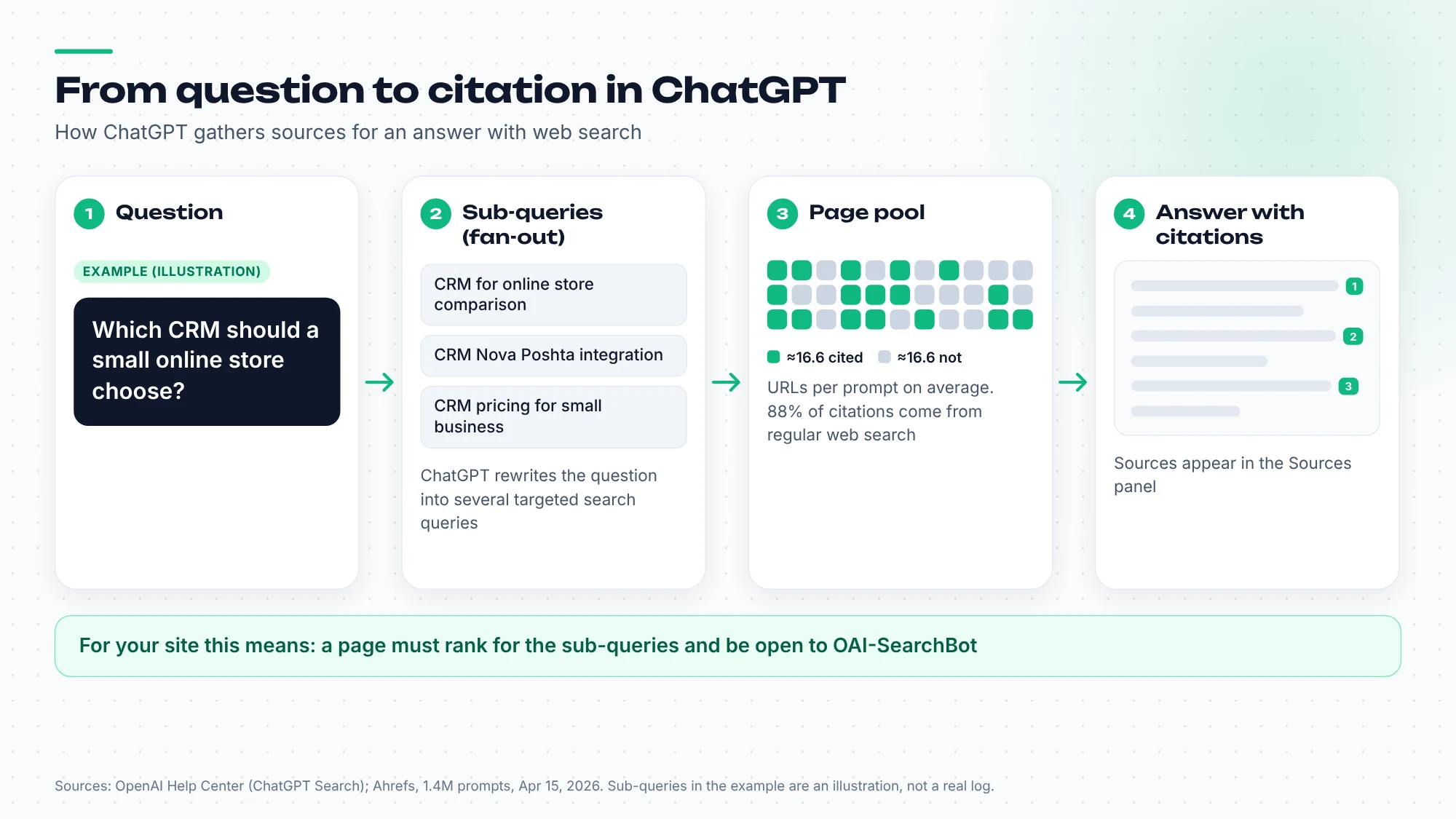
~50% of the URLs ChatGPT finds get cited; the other ~50% stay in the pool without a citation. — Ahrefs, April 15, 2026, 1.4M prompts
Which OpenAI bots visit your site and how do they differ?
OpenAI runs three bots with different jobs: GPTBot collects data for training models, OAI-SearchBot determines how sites appear in ChatGPT search, and ChatGPT-User performs actions started by a user. The bots' settings are independent: blocking one doesn't block the others, so for visibility in answers the one that matters is OAI-SearchBot.
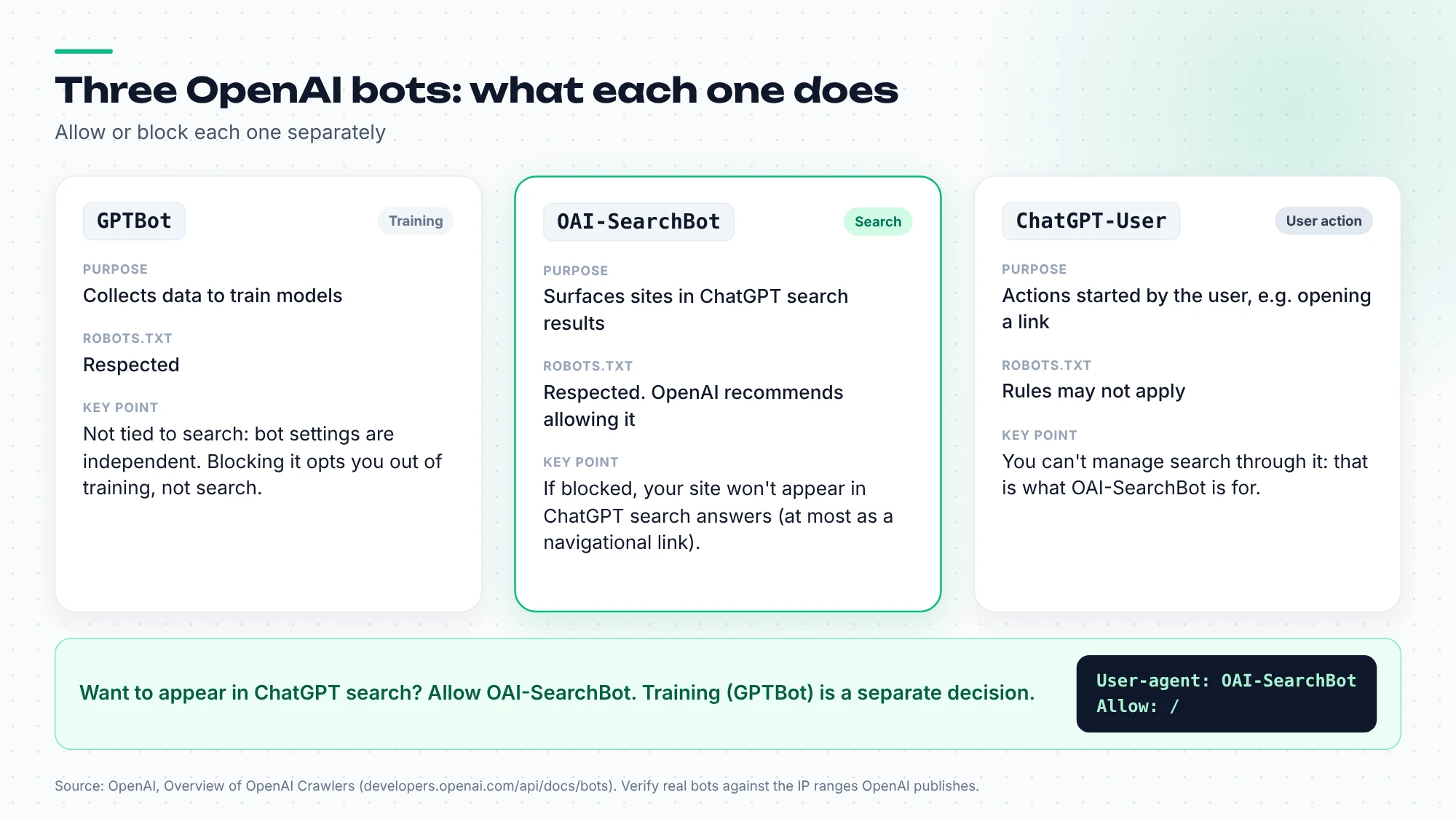
| Bot | Purpose | Respects robots.txt | Affects appearing in ChatGPT search |
|---|---|---|---|
| GPTBot | Model training | Yes | No, it handles training, not search |
| OAI-SearchBot | Showing sites in ChatGPT search | Yes; OpenAI recommends allowing it | Yes, it is the search-layer bot |
| ChatGPT-User | Actions started by a user | robots.txt rules may not apply to it | Described in the docs as a user-action tool, not an indexing one |
OpenAI's recommendation is unambiguous: allow OAI-SearchBot in robots.txt and let through requests from the published IP ranges. The ranges are published as JSON files: openai.com/searchbot.json, openai.com/gptbot.json and openai.com/chatgpt-user.json.
A typical choice for a site owner is to be in ChatGPT search without handing content over for training. It is set up like this:
# Allow the ChatGPT search bot
User-agent: OAI-SearchBot
Allow: /

# Block data collection for model training (optional)
User-agent: GPTBot
Disallow: /

# Actions started by a user
# OpenAI warns that robots.txt rules may not apply to ChatGPT-User
User-agent: ChatGPT-User
Allow: /
The GPTBot block with Disallow: / is a business decision, not a technical requirement. If you don't mind training on your materials, you can leave it out. Blocking GPTBot does not affect appearing in search, according to the documentation.
What criteria does ChatGPT use to decide which source to cite?
Officially, OpenAI says only that ranking uses multiple factors and a place in the answer isn't guaranteed. Studies offer indirect signs: cited pages have titles closer in meaning to the query and its sub-queries, appear more often in results for different sub-queries, and often give the answer near the top of the page.
Ahrefs measured title-to-query closeness as the cosine similarity of embeddings. Against the original prompt it was 0.602 for cited pages and 0.484 for non-cited ones. Against the internal sub-queries (fan-out), it is 0.656 for cited pages. This is the clearest signal available: a title that matches the meaning of the question and its sub-questions correlates with being cited.
A preprint from the National University of Singapore, "Understanding ChatGPT Citations…" (2026, not peer-reviewed; 80 queries in Chinese and English, ChatGPT 5.2-5.5 models), adds a second sign. Pages that recur in results across different sub-queries are cited more often. The authors also note that retrieval is noisy: the same question can produce different page pools.
A third sign comes from a secondary source. According to a summary of an analysis of 1.2 million answers on ziptie.dev, 44% of citations come from the first third of a page. We haven't verified the methodology, so treat the figure as a rough guide.
One more detail from Ahrefs: ChatGPT pulls in YouTube and arXiv in bulk but rarely cites them. Reddit accounts for 67.8% of non-cited URLs and only 1.93% of citations. Landing in the pool does not mean being cited.
An important caveat from Ahrefs itself: no solid conclusions can be drawn about the role of snippets and publication dates. All the signs listed here are correlations; causation is not proven.
Is a top-10 Google ranking enough to get into ChatGPT's answers?
No, and the studies disagree with each other. According to Ahrefs, only about 8% of ChatGPT citations point to pages from Google's top 10, while an early Seer Interactive test found that 87% of citations matched Bing's top 10. There is no single figure: the studies differ in method and period, so these values shouldn't be averaged.
Here is everything we found, with each study's method:
- Ahrefs, about 15,000 prompts, July 2025 data: 8% of ChatGPT citations in Google's top 10 and about 8.1% in Bing's top 10.
- Seer Interactive, 500+ citations, early 2025: 87% matched Bing's top 10. The sample is small and early, and we know the method only second-hand.
- GeekyTech, 2026: domain overlap of 0.104 with Google and 0.035 with Bing. This is a different metric: domains, not URLs.
- NUS preprint: Google Search and the OpenAI Responses API together reproduce about a quarter of cited URLs, but about half of cited hosts.
Four factors explain the discrepancy. First, the metric. Overlap by exact URL is always lower than by domain or host: ChatGPT may cite a different page of the same site that ranks in the top. Second, timing. The data was collected in different periods, and ChatGPT's search layer has changed. Third, model versions. The NUS preprint tested models 5.2-5.5, while earlier tests used others. Fourth, sub-queries. ChatGPT doesn't search for your keyword but for rewritten queries, and the top 10 for the original keyword isn't decisive for it. This is our interpretation; we haven't seen a direct experiment that separates these factors.
8% of ChatGPT citations pointed to pages from Google's top 10. — Ahrefs, ~15,000 prompts, July 2025 data
The practical conclusion doesn't depend on which figure is closer to reality. Google rankings stay useful, but judging by the data not as a direct signal: a site that is indexed and ranks is probably more likely to land in the pool (this is our interpretation). They are not a sufficient condition, and what you need to check is citation itself.
What should content look like to get cited?
Content that answers a specific sub-question near the top of the page, has a title close to the wording of the query and contains verifiable data with a named source gets cited more often. Causation for these signs isn't proven: they are derived from correlations, not controlled experiments, so treat them as a working hypothesis.
If you translate how ChatGPT chooses sources into on-page actions, you get a workflow you can finish in an hour:
- Write down 3-5 questions the page must answer, phrased the way your reader asks them. For a CRM page that is "which CRM suits a store with 50 orders a day", not "CRM systems overview".
- Make the page or section title close in meaning to the main question. This ties the page to the sub-queries the question will fan out into.
- Put a direct answer in the first paragraphs. Remember the ziptie.dev figure: 44% of citations come from the first third of a page (second-hand, methodology unverified).
- Add specifics: a number, a date, a method name, a source. A statement like "many companies do this" gives the model nothing to cite.
- Remove the intro, company history and general musings from the first third of the page. They occupy the spot where an answer is expected.
What this list doesn't include: schema markup, special tags and llms.txt. We found no data on markup affecting ChatGPT citations. For llms.txt, studies have shown no link to citations (details in the FAQ).
What technical conditions does a site need to get into ChatGPT search?
OAI-SearchBot must be able to reach your pages: it isn't blocked in robots.txt, isn't cut off by a firewall or CDN, and its requests from the published IP ranges go through. OpenAI has no webmaster console where you can confirm access or see impressions, so you have to check using your own logs.
A site blocked for OAI-SearchBot doesn't appear in ChatGPT search answers. It can still show up as a navigational link when a user looks for a specific site. This wording is given per OpenAI's documentation as summarized by an eSEOspace review.
In practice, failures more often happen at the protection layer than in robots.txt. If a WAF or CDN, for example with a "block unknown bots" rule, returns a 403 or a captcha to OAI-SearchBot, a robots.txt that allows access changes nothing. Check that requests from the IPs in searchbot.json get through, and add that range to your allowlist.
According to the same eSEOspace review, as of October 2026 OpenAI has no webmaster console, URL submission form or impression report for ChatGPT search, and the full list of search partners isn't disclosed. This means access can only be confirmed from your own server logs and citations only checked manually.
Changes to robots.txt can take about 24 hours to apply. searchengineworld.com gives this figure as a summary of OpenAI's documentation, so don't expect an instant effect.
Do brand mentions on other sites help?
There's no direct proof in the data. This is a hypothesis: ChatGPT relies on a pool of pages from search, so brand mentions on authoritative sites that end up in that pool may raise the chance of being cited. We found no test of this link, and the indirect data on ChatGPT's sources is mixed.
What the studies do show suggests it's not about the number of mentions. According to Ahrefs, Reddit makes up 67.8% of non-cited URLs and only 1.93% of citations: a platform with a huge number of mentions lands in the pool and is almost never cited. The arXiv 2601.17109 study on medical queries shows something else: institutional sources dominate ChatGPT's answers, and commercial sites account for less than a quarter of citations. But that is one subject area, and for questions about CRM or SEO the picture may differ.
Together, the two facts give a cautious conclusion. The type of site matters more than the volume of mentions, and for sensitive topics the model, judging by the data, picks institutional sources. This is our interpretation. If you work in such a niche, consider publications on industry or expert resources rather than mass placements on general-purpose platforms.
How do you check whether ChatGPT cites your site?
There is no single report, so checking combines three sources: a manual run of 15-20 questions in different sessions, referral analytics in GA4 and server logs. Each method shows its own part of the picture: manual checks see citations, GA4 sees clicks, logs see bot visits, and none gives the full picture.
Manual check. Write 15-20 questions your site should answer and ask them in different sessions with search enabled. Results are noisy (the NUS preprint authors say so), so a single run proves nothing. Record which pages ChatGPT links to and repeat a week later.
GA4. ChatGPT Search appends utm_source=chatgpt.com to outgoing source links. GA4 has no default channel for AI traffic, so you need a custom channel with a rule placed above Referral. An example condition for Source:
Source matches regex:
chatgpt\.com
Visits from apps and copy-pasted links often land in Direct, so GA4 gives a lower bound on real traffic (based on wellows.com and clickport.io).
Server logs. Filter requests by user-agent and check the IPs against the published ranges:
grep -E "OAI-SearchBot|ChatGPT-User|GPTBot" /var/log/nginx/access.logA matching user-agent with a non-matching IP may mean a spoofed request (or an outdated range list, so refresh the JSON first), and such requests shouldn't be counted as visits from OpenAI's bot. Logs only confirm that the bot visited, not that the page was cited.
What mistakes keep you out of ChatGPT's answers?
The main mistakes fall into three areas: bot access, page structure and expectations of the result. Checking takes under an hour and reveals failures a site owner may not have known about: from blocking the search bot in robots.txt to an answer buried at the end of a long page.
- Blocking OAI-SearchBot. It gets blocked along with GPTBot because people treat them as one bot. According to the documentation they are independent, and a blocked OAI-SearchBot removes your site from search answers.
- Protection that cuts off the bot. A WAF or CDN returns a 403 or a captcha even though robots.txt allows access.
- The answer at the end of the page. The first third of the text is taken up by an introduction. According to ziptie.dev (second-hand), 44% of citations come from the beginning of the page.
- A title that doesn't match the question. The page is called "Our services" instead of "How much does delivery across Ukraine cost". Per Ahrefs, title-to-query closeness is higher for cited URLs.
- Optimizing for a single keyword. ChatGPT searches by sub-queries, and a page that covers no narrow sub-query stays in the pool without a citation.
- Betting on llms.txt. There is no confirmation that OpenAI reads this file, and the time goes into something that, according to available studies, doesn't affect citation.
FAQ
Can you pay for a place in ChatGPT's answers?
In the OpenAI materials we used, there is no paid way into search sources. The help article describes ranking by multiple factors and says outright that placement isn't guaranteed. ChatGPT search also has no webmaster console, URL submission form or impression report, so there is nowhere to arrange a citation.
Will blocking GPTBot affect visibility in ChatGPT?
According to OpenAI's documentation, no. GPTBot collects data for training models, while OAI-SearchBot handles how sites appear in search. The bots' settings are independent, so you can block GPTBot and leave OAI-SearchBot open. The key is not to block both bots with one rule by mistake.
How many sources does ChatGPT show in an answer?
Fewer than its competitors. According to arXiv 2604.25707 (602 prompts), ChatGPT gives 6.88 citations per prompt on average, Google 12.06 and Perplexity 16.35. These figures depend on the prompt sample and on how the authors counted citations, so they can't be compared with the Ahrefs data (about 16.57 cited URLs per prompt): the sample, model version and counting method there are different. This is our interpretation: with fewer citations, competition for each place in a ChatGPT answer is tougher than in Perplexity.
Do you need llms.txt for ChatGPT to cite your site?
There is no confirmation that OpenAI reads this file. SE Ranking's study of 300,000 domains, Ahrefs' analysis (97% of llms.txt files with zero requests) and Search Engine Land's data (6 citations out of 18,000) found no link between the file and citations. You can create it, but don't expect an effect.
How quickly does ChatGPT react to robots.txt changes?
Changes can take about 24 hours to apply. This figure comes from searchengineworld.com's summary of OpenAI's documentation, not a guarantee. After an edit, wait a day, check in your server logs that OAI-SearchBot gets access, and only then judge the result.
Where to start this week
Open robots.txt and check that OAI-SearchBot isn't blocked, either directly or by a blanket rule. Then find its requests in your server logs and confirm the IPs match openai.com/searchbot.json. Next, write 15 questions from your niche and ask them in different ChatGPT sessions with search on: that shows you how ChatGPT chooses sources in your particular topic and whom it cites now. Rewrite one page that should answer such a question: a title built around the sub-question, the answer in the first paragraphs, data with a source. If you need a systematic approach instead of one-off fixes, take a look at our work on ChatGPT promotion.
Sources
- OpenAI Help Center: ChatGPT Search
- OpenAI: crawler documentation (GPTBot, OAI-SearchBot, ChatGPT-User)
- OpenAI: OAI-SearchBot IP ranges
- OpenAI: GPTBot IP ranges
- OpenAI: ChatGPT-User IP ranges
- arXiv 2604.25707: citation counts in ChatGPT, Google and Perplexity
- arXiv 2601.17109: ChatGPT sources for medical queries
About the author

The LuchanLabs Team
SEO and AIO strategists
We rank websites at the top of Google and make brands visible inside ChatGPT, Gemini and Perplexity answers. We write about what we test on client projects every day.
All blog articlesRelated articles
 AI Overview / GEO
llms.txt: What It Is, How to Create One and Whether It Works in 2026
llms.txt promises to tell AI which pages matter. We break down the format, the Ahrefs and SE Ranking data and Google's position, then show step by step how to create one.
 The LuchanLabs Team9 min read
 Content marketing
Top 5 AI Tools for Writing Content in 2026
The AI writing assistant market is heading for $4.88bn, so the question is no longer whether to use one, but which. Here are five proven tools with real pricing, genuine strengths and the limits their landing pages never mention.
The LuchanLabs Team9 min read